5 Top Warehousing Solutions for a Growing E-Commerce Business
When order volume climbs, the warehouse that felt spacious last quarter can suddenly feel cramped. Receiving slows, inventory counts drift and carriers idle at the dock.
Every provider promises scale, yet the right warehousing setup keeps your stock moving as demand rises.
Methodology for Evaluating Top Warehousing Solutions
Knowing what warehousing solutions work best for growing e-commerce businesses starts with a clear yardstick. Research from the Council of Supply Chain Management Professionals found that 87% of shippers increased their use of outsourced logistics services, a 25% jump year over year. Another 82% say third-party logistics (3PL) providers improve customer service.
The top companies meet five criteria, beginning with reliability and service guarantees, which show how well a partner protects your customer promise. Technology with real-time visibility keeps stock accurate across channels, and compliance and certifications matter more as your product mix widens. Scalability covers seasonal spikes, while specialization shows whether a provider fits your product type.
1. Keller Logistics
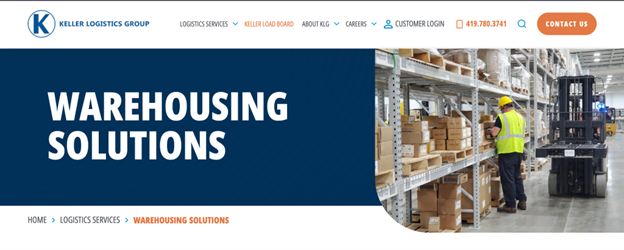
For growing brands that need dependable space for inventory as volume increases, Keller Logistics Group is a great fit. Unlike pick-pack-ship providers, it offers turnkey warehousing services and secondary contract packaging across 3 million square feet of warehouse space.
Key features:
- Service guarantee: The company describes itself as the only asset-based 3PL guaranteeing all its services, with coverage specific to each business unit.
- Real-time tracking: Proprietary 1K software, run through its TMW system, provides customers with live tracking that may ease delays in receiving.
- Food-grade compliance: Most of its warehouses are food-grade and Safe Quality Food (SQF) certified.
2. ShipBob

ShipBob suits high-volume direct-to-consumer (DTC) brands that want an all-in-one tech stack. Because e-commerce requires roughly three times the warehouse space of brick-and-mortar retail, a platform that automates inventory placement across a network can help sellers keep pace.
Key features:
- Unified tools: Order management, stock control and analytics sit in one system.
- Automated placement: Automation handles distribution and replenishment throughout its network.
- Integrations and speed: Connections to Shopify, Amazon and Oracle NetSuite support multichannel selling, and 2-Day Express Shipping helps meet delivery expectations.
3. ShipMonk
When B2B or cross-border orders join the mix, ShipMonk offers brands a tailored, security-minded option. Its technology gives teams ways to connect existing systems, while its fulfillment network supports custom packaging, bonded warehousing and multichannel integrations.
Key features:
- Connected technology: Order, warehouse and inventory management tools pair with API and developer tools for custom integrations.
- Customization and reach: Custom packaging and personalization come with B2B and cross-border fulfillment, including bonded warehouses.
- Security and integrations: System and Organization Controls 2 (SOC-2) compliance backs secure operations and integrations cover Shopify, BigCommerce, eBay and Loop Returns.
4. Red Stag Fulfillment
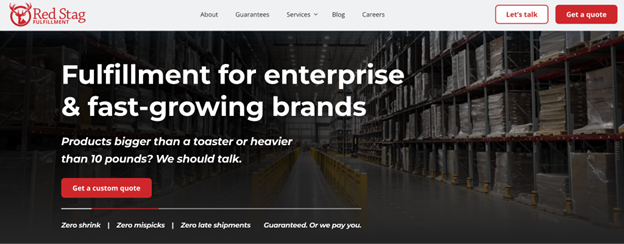
For heavy and oversized products, Red Stag Fulfillment is a natural fit. Because its site targets items bigger than a toaster or heavier than 10 pounds, the company says it takes on work most 3PLs avoid.
Key features:
- Three zeros guarantee: The policy covers zero shrink, zero mispicks and zero late shipments, and the company promises to pay if it misses.
- Real-time dashboard: One dashboard tracks live inventory and kitting progress across its East and West warehouses in Sweetwater, Tennessee, and Salt Lake City, Utah.
- Large-item specialization: Red Stag focuses on items heavier than 10 pounds, making it a good fit for brands whose inventory may be difficult for standard 3PLs to handle.
5. Flexport

Flexport stands out for brands that pair international freight with domestic warehousing. Importers moving goods from overseas suppliers may value having a single provider for both legs of the supply chain.
Key features:
- Unified view: Shipments, orders and inventory appear together in a single AI-powered platform.
- Freight plus fulfillment: The service menu covers ocean and air freight, e-commerce and B2B fulfillment and a warehouse network.
- Customs support: Automated customs brokerage and AI classification tools may ease cross-border paperwork.
Comparing Your Top Warehousing Options
Needs shift as volume grows, so a quick side-by-side view helps. Use it to match warehousing solutions for growing e-commerce businesses to your own situation.
| Company | Best For | Standout Feature | Key Integrations or Services |
| Keller Logistics | Bulk warehousing and secondary contract packaging for growing brands | Per-business-unit service guarantee plus real-time 1K tracking | Majority food-grade and SQF certified, 3 million square feet of warehouse space |
| ShipBob | High-volume DTC brands | All-in-one platform with analytics | Shopify, Amazon, Oracle NetSuite |
| ShipMonk | Customization plus B2B and cross-border needs | SOC-2 compliance and custom packaging | Shopify, BigCommerce, eBay, Loop Returns |
| Red Stag Fulfillment | Heavy or oversized products | Three zeros guarantee | Real-time dashboard across East and West warehouses |
| Flexport | International freight plus domestic warehousing | AI-powered platform with automated customs brokerage | Ocean freight, air freight, e-commerce and B2B fulfillment |
Frequently Asked Questions
Scaling raises practical questions about cost, timing and channel coverage. The answers below can sharpen your next decision, whether you are comparing providers or weighing an in-house upgrade.
Q: How should growing e-commerce businesses compare warehousing providers?
A: Base the comparison on key evaluation factors — reliability, service guarantees, real-time visibility, compliance, scalability and specialization for your product type. Compare the standout features of each provider to assess which company best fits your needs.
Q: When should a growing business consider a third-party warehouse?
A: Consider switching to a 3PL warehouse when order volume rises, fulfillment starts competing with core activities for your time and attention, or when warehouse space and internal operations reach a breaking point.
Q: Can a single warehousing partner handle multiple sales channels?
A: Yes. The providers above show different approaches, from ShipBob’s Shopify, Amazon and Oracle NetSuite integrations to ShipMonk’s API tools and Flexport’s unified view of shipments, orders and inventory. Real-time visibility and integration can keep your stock counts consistent across every channel.
Choosing the Right Warehousing Partner for Your Next Growth Stage
When evaluating warehousing solutions for growing e-commerce businesses, the right fit depends on your growth stage, product type and volume. The top providers each meet key criteria, but your best match depends on your specific needs.
Determine a provider’s reliability, visibility, compliance and scale priorities and test it against your next growth milestone.
*Please note that this list includes sponsored content. Some of the companies, products, or services featured have entered into commercial agreements for placement. Sponsored placements do not necessarily reflect an endorsement and should be considered alongside other options in the marketplace.