
AI will only transform the supply chain if it speaks the right language
Warehouses are under sustained pressure to modernize. Labor shortages persist, operating costs continue to rise, and customers expect faster, more reliable delivery with little tolerance for disruption. In response, artificial intelligence (AI) has become a central theme in supply chain strategy, often positioned as the route to greater efficiency and resilience.
Yet, despite this momentum, progress on the warehouse floor remains uneven. Many operations still rely on spreadsheets, manual processes, and the judgement of a small number of experienced individuals to keep goods moving. AI is widely discussed, but its practical impact is often limited.
The issue is not a lack of ambition or awareness, but rather that technology only delivers value when it is built on data that reflects how warehouses actually operate – and when that intelligence is accessible in ways people can easily understand.

From automation to anticipation
When applied with discipline, AI is already improving core warehouse operations. Automation in picking has reduced error rates and shortened fulfilment times, while route optimization tools help transport teams cut fuel usage, avoid congestion, and improve delivery performance. Continuous inventory monitoring also reduces the need for manual admin and highlights discrepancies earlier.
Fewer mistakes translate directly into fewer failed deliveries, less rework, and faster responses to customer issues. The biggest gains appear when AI moves beyond automating individual tasks and starts to identify patterns across the wider operation.
By analyzing operational data alongside service performance, AI can surface issues before they become visible on the warehouse floor. Pressure building in a particular picking zone, repeated delays on certain routes, or a supplier that’s gradually becoming less reliable are all signals that are easy to miss when teams are focused on daily execution. Earlier visibility allows managers to step in sooner and prevent minor inefficiencies from turning into service failures.
In an environment where recovery time is limited and reputational impact is immediate; anticipation matters as much as speed.
When intent matters more than innovation
As AI becomes more prominent, supply chain leaders face pressure to invest quickly. But warehouses are not experimental environments. Missed deliveries, stock errors, and system downtime carry immediate operational and commercial consequences.
Successful AI adoption starts with intent rather than novelty. Each investment should be assessed against clear operational outcomes: improved accuracy, higher throughput, reduced cost, or lower dependence on manual workarounds. When the return on investment is unclear, adoption often stalls, and systems are quietly bypassed in favor of familiar processes.
Tools that look impressive in demonstrations can struggle in live operations if they fail to integrate with existing systems or disrupt established workflows. Warehouses need technology that works reliably, complements existing infrastructure, and supports the pace of day-to-day decision-making. Ultimately, pragmatic innovation, rather than wholesale reinvention, is what drives lasting change.
Why data is the real language
One of the most persistent barriers to effective AI adoption is not the technology itself, but the data it relies on. AI systems are only as useful as the information they are built on. If data structures do not reflect how employees work, think, and make decisions, the outputs will never feel relevant or trustworthy, no matter how advanced the technology is.
For AI to ‘speak the same language’ as warehouse teams, the data must first do the same. That means operational data needs to mirror real workflows, real constraints, and real priorities on the warehouse floor. When data is aligned with how people operate, AI is elevated to a practical decision-support tool.
This is where natural language interfaces add real value. When teams can query systems in plain English, insight becomes accessible at the point of need. Questions such as why deliveries were late, which orders are at risk, or where capacity is under strain can be answered without navigating complex reports or dashboards. This removes friction from decision-making, shortens response times, and helps teams act while there is still time to adjust plans.
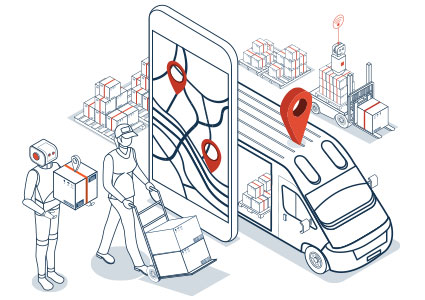
AI can assess routes, loading times, traffic patterns, and delivery locations together to identify the likely cause of delays. Often, the issue lies elsewhere in the network rather than with the driver. By lowering the barrier to insight, natural language tools reduce training time, limit reliance on specialists, and allow operational staff to focus on action rather than interpretation.
Making change last
Technology alone does not drive lasting change. Warehouses depend on experience, and long-serving employees hold deep operational knowledge. Many are cautious about new systems, often for good reasons. Past technology projects have promised efficiency but delivered disruption instead.
Adoption improves when people can see how AI helps them make better decisions and reduces pressure during the working day. The most effective deployments are incremental: shaped by feedback, introduced alongside existing processes, and focused on solving specific operational problems. Over time, AI can take on more responsibility, highlighting risk earlier and supporting planning decisions, while people remain responsible for oversight and judgement.
Presenting AI as a tool that supports experience rather than replaces it is essential. When teams see systems reinforcing their knowledge instead of challenging it, confidence grows and resistance fades.
Speaking the same language
AI has the potential to reshape warehouse operations, but only when it aligns with the realities of how work is done. Systems that require translation, interpretation, or specialist intervention struggle to gain traction in high-pressure environments.
Transformation happens when data reflects real operations and intelligence is delivered in forms people can use instinctively. When that alignment exists, AI stops being an abstract capability and becomes a practical tool, supporting better decisions, earlier intervention, and more resilient operations across the supply chain.
John Burgess
With a PhD in Supply Chain Strategy and a career spanning various consultancy roles, John Burgess is currently the Director of Innovation at Balloon One. As a strong believer in continuous improvement principles, John takes a strategic perspective to deliver tangible results across customers’ businesses.