As European manufacturers seek greater resilience in an increasingly uncertain world, production is moving closer to home. By Henrike Wonneberger
For decades, the logic of global manufacturing was simple: make it where it’s cheapest, ship it where it’s needed. That logic is now cracking under the pressure of disrupted trade routes, tightening regulation, and a growing recognition that the true cost of a distant supply chain rarely appears on a purchase order.
Across Europe, industrial companies are restructuring where they source their components. Not by abandoning global suppliers wholesale, but by making more deliberate choices about which parts are too critical, too complex, or too risky to produce on the other side of the world. The trend goes by several names, such as reshoring and nearshoring, but the underlying shift is the same: proximity is becoming a competitive advantage again.
The numbers behind the shift
According to the EIB Investment Survey 2025, 19 percent of EU importing firms are actively diversifying or increasing the number of countries they source from. A Capgemini Reindustrialization Report 2025 found that 73 percent of executives expect so-called friendshoring — sourcing from politically stable, trade-aligned partners — to account for a significant share of their operations going forward. More than half of the companies surveyed had already invested in nearshoring or a combination of nearshoring and reshoring in 2025. Reshoring refers here to moving production back to a company’s home country, while nearshoring means shifting it to a geographically close region.

Several forces are converging to make this economically sensible. One example is the disruption of Red Sea shipping lanes that has forced vessels to reroute around the Cape of Good Hope, extending transit times and introducing volatility into freight costs. What looked like a cost-efficient supply chain from Asia can quickly become an expensive gamble when a container ship is three weeks late and a production line is standing idle.
Contract manufacturing as the practical entry point
Reshoring and nearshoring do not mean a company has to produce everything itself. Contract manufacturing has quietly become the most accessible route back to regional production. Rather than investing in machinery, hiring specialist staff and managing a facility, companies can hand production of specific components to established European manufacturers who already have the capacity, certifications and quality systems in place.
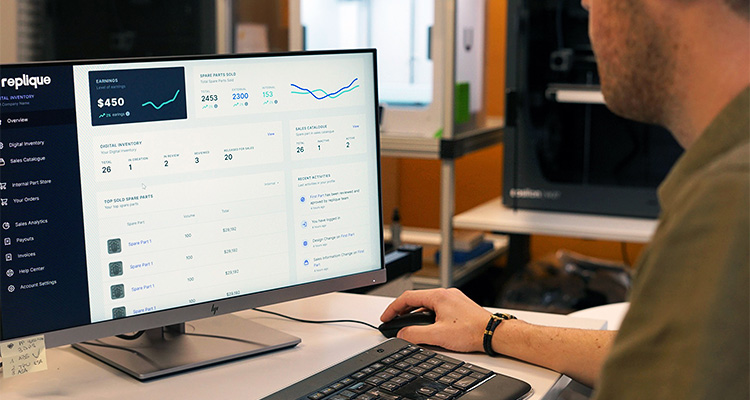
This model significantly reduces the financial and operational risk of reshoring. A company can move a critical spare part or low-volume component to a European contract manufacturer, test the economics, and scale from there — without a long-term capital commitment. Platforms such as Replique, which provide access as a single point of contact to a network of qualified manufacturers across Europe for on-demand production, have made this kind of selective regionalization practical even for mid-sized firms that would never have considered building their own local capacity.
For spare parts, tooling components, and products with high variety but low individual volumes, the contract manufacturing route is often more economical than the unit price comparison would suggest.
Beyond the unit price
For years, procurement decisions were driven largely by unit price. The emerging framework, increasingly referred to as total cost of ownership, asks harder questions. What does safety stock cost when lead times are unpredictable? What happens to margins if a supply failure halts production for a week? When those factors are included, the economic case for regional sourcing often looks very different, and in categories with high part variety, volatile demand or strict quality requirements, it frequently tips decisively toward Europe.
Not a return, but a rebalancing
None of this means the end of global manufacturing. The more nuanced reality emerging in 2026 is what is sometimes referenced as rightshoring: a mix of offshore, nearshore and local production, calibrated to the risk profile and strategic importance of each component category. High-volume, low-risk commodity parts may well stay in Asia. But the critical or specialized components, the low-volume run with demanding documentation requirements will be made closer to home. That is a more modest shift than the headlines sometimes suggest, but in manufacturing, modest shifts sustained over time tend to be the ones that stick.
Henrike Wonneberger
www.replique.io/en
Henrike Wonneberger is COO of Replique, which offers an industrial 3D printing platform that enables OEMs to provide parts on-demand anytime and anywhere to their customers through a global, decentralized, and secure 3D printing network.