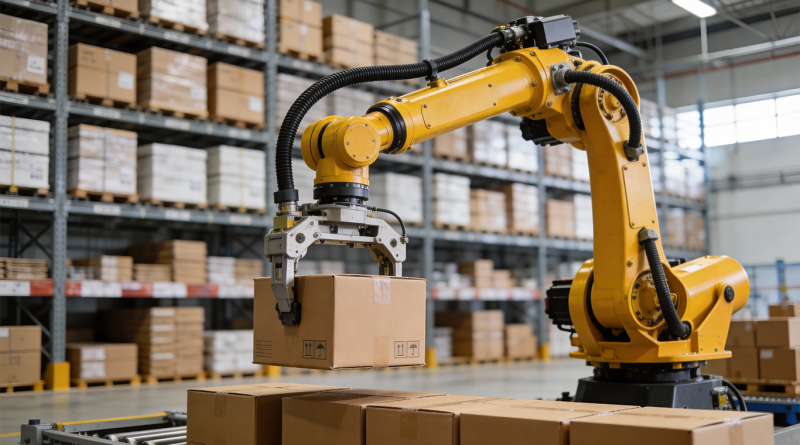
Automation comes to the warehouse floor as mid-sized companies embrace robotics
As robotics becomes more common, the design of warehouses themselves is beginning to change. Traditional distribution centers were built around long aisles, forklifts and manual picking. Workers moved through large facilities retrieving items from shelves before transporting them to packing stations. This approach worked well when order volumes were predictable and product ranges were relatively stable. E-commerce has altered that equation.
Online retailers must now process thousands of smaller orders rather than large pallet shipments. Products also move faster through fulfilment centers, creating pressure to reduce the time between order placement and shipment. Automation systems are helping warehouses adapt to these new conditions. Mobile robots, for example, can transport entire shelving units to workers instead of requiring employees to walk long distances across the facility. This approach, often described as goods to person fulfilment, can significantly reduce travel time during the picking process.
Other systems focus on automated sorting and packaging. Robotic arms equipped with machine vision can identify and pick individual items, placing them into bins or boxes with increasing accuracy. While these technologies are still evolving, they are becoming more capable of handling a wider variety of products.Warehouse operators are also investing in software that provides real time visibility into operations. These platforms track inventory movement, robot performance and order flow across the facility. By analyzing this data, companies can identify bottlenecks and adjust workflows to improve efficiency.
For many logistics managers, the goal is not to eliminate human workers but to redesign facilities so that people and machines operate together more effectively.
Investment is accelerating across the industry
The growing accessibility of warehouse automation is attracting significant investment from both technology firms and logistics providers. Robotics startups continue to secure funding as investors recognize the scale of the opportunity. Warehousing represents a critical component of global supply chains, yet many facilities still rely heavily on manual processes. That gap creates a large market for companies that can deliver reliable and affordable automation solutions.
Established logistics technology providers are expanding their offerings as well. Many companies that previously focused on warehouse management software are now developing robotics platforms or partnering with hardware manufacturers.Large retailers remain among the most aggressive adopters of automation. Their scale allows them to experiment with advanced technologies such as robotic picking systems, automated palletizing and AI driven demand forecasting.
However, the most notable shift is the growing number of mid sized firms entering the market. Regional distributors, third party logistics providers and manufacturers are increasingly testing robotic systems in selected facilities. These pilot programs allow operators to measure productivity improvements before rolling out automation across larger networks.
In some cases, companies begin with a small fleet of robots that handle specific tasks such as transporting goods between storage areas and packing stations. Over time, additional robots or automation modules can be added as operational needs evolve.This incremental approach reduces risk while allowing organizations to gradually build expertise in managing automated environments.
Industry analysts expect this trend to continue as costs decline and the performance of robotics systems improves.
The future warehouse will be hybrid
Despite rapid technological progress, fully automated warehouses remain relatively rare. Many tasks within distribution centers still require human judgment, adaptability and fine motor skills. Items with unusual shapes, fragile packaging or inconsistent labeling can be difficult for machines to handle reliably.
For this reason, the warehouse of the future will likely be a hybrid environment where people and machines collaborate. Robots will handle repetitive transportation tasks, heavy lifting and high speed sorting. Human workers will focus on activities that require problem solving, product knowledge or customer service considerations.
Training will become an increasingly important component of warehouse operations. Employees will need to understand how to interact safely with robotic systems and how to monitor automated workflows. Companies are also beginning to create new roles focused on robotics management and maintenance. Technicians responsible for overseeing robot fleets, analyzing operational data and resolving technical issues are becoming essential members of logistics teams.
This shift reflects a broader transformation within supply chains. Warehouses are evolving from simple storage facilities into highly coordinated technology environments that support fast moving commerce. Organizations that successfully integrate automation with skilled human labor may gain a significant advantage in speed, accuracy and operational resilience.
The expansion of robotics into smaller and mid sized warehouses suggests that automation is entering a new phase. What once appeared to be an experimental technology used by only the largest retailers is becoming a practical tool for companies across the logistics sector. As adoption continues to spread, the modern warehouse will increasingly resemble a collaborative workspace where humans and machines work side by side to keep the global flow of goods moving efficiently.
Source: