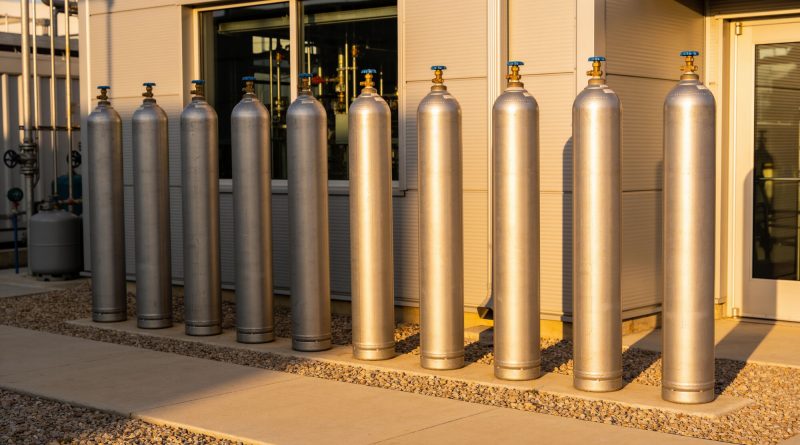
China’s helium export ban reveals cracks in global supply chains
Subscribe to our free newsletter today to keep up to date with the latest renewable energy news.
China’s decision to suspend helium exports may appear insignificant at first glance. Helium represents a relatively small commodity market, attracts little public attention and rarely makes headlines outside the industrial gas sector. Yet the latest export restrictions show how niche materials can expose weaknesses across global manufacturing supply chains.
The temporary ban, announced by China’s Ministry of Commerce and General Administration of Customs on July 10, follows renewed instability across the Middle East, where much of the world’s helium production is concentrated. Although China is not a leading helium producer, the measure adds uncertainty to a market that supports semiconductor fabrication, medical imaging, aerospace, scientific research and advanced manufacturing.
The restrictions also reinforce a wider pattern. Manufacturers increasingly recognize that supply chain resilience depends not only on securing major raw materials but also on maintaining access to specialist inputs that often receive little attention until disruption occurs.
China’s move reflects supply protection rather than market control
Unlike rare earth elements or processed critical minerals, China does not dominate global helium production. Industry estimates suggest the country produces less than 15 percent of the helium it consumes, relying heavily on imports to meet domestic demand. Qatar remains one of the world’s largest helium suppliers, while Russia has become an increasingly important source in recent years.
Rather than demonstrating market power, Beijing’s export suspension appears designed to preserve domestic supply while geopolitical tensions threaten international production and transport networks.
That distinction is important. The restriction is unlikely to remove a significant share of global production. Instead, it reduces flexibility within a market where buyers, distributors and industrial users already have limited options.
Europe could feel the impact more than other regions. Chinese traders have become an important route for Russian helium entering European markets following sanctions and changing trade patterns. Closing that channel may tighten availability for manufacturers already facing higher procurement costs and longer delivery times.
For procurement teams, the announcement is another reminder that supply chain resilience increasingly depends on understanding secondary trade flows rather than focusing solely on where raw materials originate.
Helium remains difficult to replace across advanced industries
Despite its association with party balloons, helium performs several industrial functions that remain difficult to substitute.
Semiconductor manufacturers rely on helium for leak detection, cooling systems and controlled production environments during chip fabrication. Precision is essential throughout these processes, making uninterrupted gas supplies important for maintaining manufacturing efficiency and product quality.
Healthcare is another major source of demand. Liquid helium cools superconducting magnets inside many MRI scanners, allowing them to operate at extremely low temperatures. While newer equipment has reduced helium consumption through recycling systems, hospitals and imaging providers continue to depend on reliable supplies.
The aerospace sector uses helium for pressure testing, rocket systems and specialist manufacturing processes. Scientific laboratories, fiber optic manufacturers and quantum computing researchers also rely on its unique physical properties.
Unlike many industrial materials, helium cannot be manufactured commercially. It is recovered during natural gas production, making global supply dependent on a relatively small number of extraction and processing facilities.
That concentration limits the industry’s ability to respond quickly when production or transportation is disrupted.
Resilience is becoming a strategic procurement priority
The immediate impact of China’s export suspension may prove manageable if geopolitical tensions ease and alternative supplies remain available. Even so, the latest development illustrates how little flexibility exists within many industrial supply chains.
Many manufacturers have already broadened supplier networks, increased inventories of critical materials and invested in recycling technologies. Helium recovery systems are becoming more common within semiconductor facilities and research institutions because they reduce operating costs while lowering exposure to supply interruptions.
Procurement teams are also placing greater emphasis on long-term agreements with industrial gas suppliers instead of relying on short-term purchases during periods of stable pricing.
None of these measures eliminates risk. New helium production projects require years of investment, specialist liquefaction infrastructure and dedicated transport capacity before reaching commercial output.
The broader lesson extends beyond helium.
Recent disruptions involving neon, gallium, rare earth elements and other specialist materials have shown that modern manufacturing depends on complex supply networks where relatively obscure inputs can influence production schedules, investment decisions and customer deliveries.
China’s latest export restrictions are therefore more than a temporary helium story. They demonstrate how geopolitical uncertainty continues to reshape industrial procurement strategies and why manufacturers that understand supply chain dependencies beyond their immediate suppliers will be better prepared for future disruptions.
Source