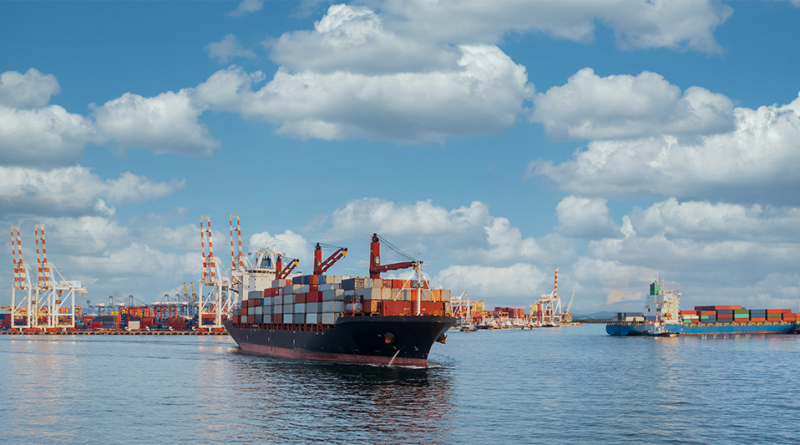
Climate and conflict are squeezing global supply chains
Subscribe to our free newsletter today to keep up to date with the latest renewable energy news.
Global shipping is confronting a problem that goes beyond another temporary rise in freight rates. Conflict, constrained waterways, port congestion and changing weather conditions are placing pressure on several parts of the maritime network at the same time.
That matters because more than 80% of world trade is transported by sea. The system has been built around speed, scale and dependable access to a relatively small number of major routes. When those routes function normally, manufacturers can source components across continents with remarkable efficiency. When several are constrained at once, the economics change quickly.
The signs are already visible. Global container freight rates rose for five consecutive weeks through early July, according to logistics company Flexport. Spot rates from Asia to the US West Coast had increased about 120% since mid-May, with Asia-to-US East Coast rates up about 85%. Close to 11% of the global container fleet was sitting at anchor waiting for berths in late June, the highest proportion since 2022.
The Financial Times has framed the latest phase of the problem around the combined effects of war and climate pressure on global shipping costs. The larger issue for industrial companies is whether events once treated as exceptional are becoming frequent enough to change how supply chains should be designed.
A handful of chokepoints carry an uncomfortable share of global trade
Maritime trade depends heavily on narrow passages that dramatically shorten journeys between major production and consumption centers.
The Suez Canal is the clearest recent example. Security risks around the Red Sea forced many shipping companies to send vessels around the Cape of Good Hope instead. The alternative keeps cargo moving, but it requires additional sailing time, fuel and vessel capacity.
UN Trade and Development reported that by May 2025 tonnage passing through the Suez Canal remained 70% below 2023 levels. Rerouting helped push global ton-miles, which measure both cargo volume and distance traveled, up almost 6% in 2024. Trade volumes grew far more slowly.
This distinction matters. A shipping company can carry the same amount of cargo and still require considerably more capacity if each voyage becomes longer. UNCTAD estimated that rerouting around Red Sea and Panama Canal disruptions had increased global vessel demand by 3% and container ship demand by 12% by mid-2024.
The Strait of Hormuz adds another concentration risk. UNCTAD estimates that the waterway carries 11% of global trade and roughly one-third of seaborne oil. Disruption there can affect energy transport, fuel costs and freight economics far beyond the region itself.
For manufacturers, the vulnerability comes from the interaction among these routes. A problem in one corridor can often be absorbed through rerouting. Problems affecting several corridors can consume vessel capacity, lengthen lead times and place pressure on freight rates across routes that are geographically distant from the original disruption.
That makes the cost of a chokepoint difficult to isolate. The commercial effect is transmitted through vessel availability, port schedules, insurance, fuel consumption and inventory requirements.
Climate risk is becoming a freight-cost problem
The Panama Canal illustrates a different form of constraint. Unlike disruption caused by military conflict, canal capacity depends in part on freshwater availability. Gatun Lake provides the water required for vessel transits, making rainfall and reservoir management operational issues for global trade.
The Panama Canal Authority said in August that the maximum authorized draft for vessels using its Neopanamax locks would fall to 48 feet on Aug. 26 and 47.5 feet on Sept. 3. The authority said the changes were based on water levels and projections for Gatun Lake. Daily transit numbers were not expected to change under the announced measures.
Draft restrictions can still affect shipping economics. A vessel that cannot sit as deeply in the water may have to reduce its cargo load. Carriers can respond through lighter loading, schedule changes or adjustments elsewhere in their networks.
This is not the canal’s first encounter with water-related disruption. UNCTAD calculated that climate-related low water levels in Panama contributed heavily to an increase in dry bulk freight rates between October 2023 and January 2024.
Longer routes create a second problem. Rerouting vessels consumes more fuel and raises emissions. UNCTAD reported that greenhouse gas emissions from shipping increased 5% in 2024, while only 8% of global fleet tonnage was equipped to use alternative fuels.
Shipping companies are being asked to decarbonize at the same time that geopolitical and physical disruptions can force ships to sail farther.
For supply chain managers, climate exposure is no longer confined to corporate emissions targets. Water levels, extreme weather and port resilience can influence capacity, transit times and freight budgets. Infrastructure that was once treated as a fixed part of the transport network increasingly has to be assessed as a variable.
Manufacturers may need to price volatility into the supply chain
The response does not necessarily require abandoning global sourcing. Low-cost international production, specialized suppliers and large-scale maritime transport still provide powerful economic advantages. The problem is that many supply chains were optimized using assumptions about transit times and freight availability that may no longer be reliable enough for every product category.
For decades, reducing safety stock released working capital and supported lean manufacturing. If shipping schedules become less predictable, carrying additional inventory for selected components can function as insurance against production interruptions.
Supplier strategy is another consideration. Dual sourcing or regional sourcing may cost more on paper than purchasing from a single low-cost supplier. The calculation looks different when it includes the cost of halted production, emergency airfreight or lost sales caused by a delayed shipment.
Procurement teams may also need to examine freight contracts differently. A low spot rate offers little protection if capacity disappears when demand rises. Longer-term arrangements can carry a premium but may provide greater certainty around space and pricing.
The inflationary consequences extend beyond logistics departments. UNCTAD estimated that if the freight-rate increases seen between October 2023 and June 2024 had persisted through the end of 2025, global consumer prices could have risen by 0.6%. Small island developing states faced a potential increase of 0.9%, with processed food prices potentially rising 1.3%.
Those estimates illustrate how transport costs move through an economy. Higher freight bills can raise landed costs, working-capital requirements and production expenses before reaching the customer.
The strategic question for manufacturers is no longer simply how to minimize freight spending. It is how much predictability is worth.
A supplier closer to a factory, additional safety stock or reserved shipping capacity can appear inefficient when transport networks are operating normally. Each can become valuable when a canal loses usable draft, a security crisis closes a route or congestion absorbs available capacity.
Global trade is unlikely to retreat from the sea. The economics remain too compelling. What is changing is the value companies may need to assign to resilience alongside efficiency.
Source:
Financial Times