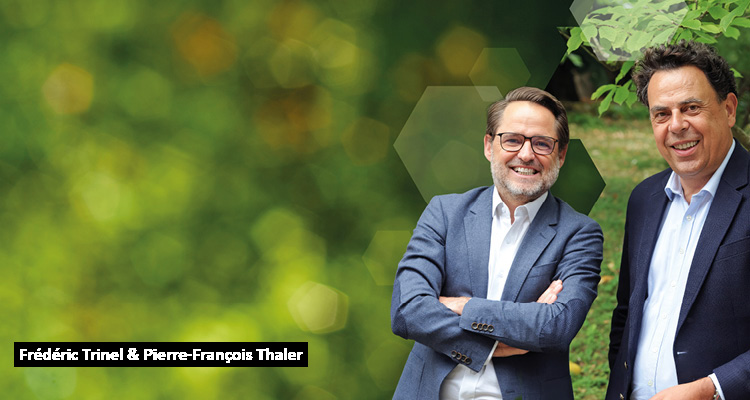
Pierre-François Thaler on the founding of EcoVadis and how it has become an influential platform
When Pierre-François Thaler co-founded Ecovadis in 2007, sustainability ratings were barely a concept in procurement circles. Nearly two decades later, the platform he built with co-founder Frédéric Trinel influences more than $2.5 trillion in global spend. As regulatory pressures mount and AI continues to reshape both opportunities and risks in ESG reporting, EcoVadis remains at the heart of conversations about sustainable procurement. We speak with Pierre-François to discuss his career journey and position in the industry, as well as current trends like an emerging digital divide across the supply chain.
Let’s start with an introduction to you. What motivated you to create a dedicated sustainability ratings platform?
When my co-founder Frédéric Trinel and I started EcoVadis in 2007, the ‘gap’ was a total lack of transparency in the global supply chain. At the time, I was at Ariba (now SAP Ariba), and I saw that while procurement was becoming digitized, there was no reliable way to assess the environmental or social impact of suppliers.
Large companies were starting to make CSR commitments, but they had no idea what was truly happening three levels deep in their supply chains. We realized that if you couldn’t measure it – and measure it consistently across borders – you couldn’t change it. We wanted to create a ‘common language’ for sustainability that didn’t require every company to reinvent the wheel. It’s from that idea that EcoVadis was born.
How have you ensured the ratings remain genuinely meaningful as you’ve grown?
Firstly, I’m proud to say that we have now rated more than 175,000 companies to date, as highlighted in our latest Purpose Report.
Scale is the enemy of quality if you don’t have the right checks. We’ve stayed meaningful by refusing to rely solely on automated ‘scraping’ or self-assessments. We have nearly 500 in-house analysts who manually verify the evidence.
A rating is only as good as the data behind it. EcoVadis’ methodology is built on globally recognized frameworks, including the Ten Principles of the UN Global Compact, the International Labour Organization (ILO) conventions, the Global Reporting Initiative’s (GRI) standards, and more. The methodology is also regularly reviewed and updated to reflect evolving regulatory requirements, scientific guidance and stakeholder expectations.
For us it’s not just about providing ratings but also engaging with suppliers and supporting them on their journey of improvement. It’s why companies receive detailed scorecards outlining strengths and areas for improvement, and those with questions about their results can submit a Scorecard Inquiry or request a call with our analysts to clarify and review specific scoring decisions.
It’s also why we recently launched our new Community platform, which provides a trusted space for suppliers to collaborate, exchange insights, tackle complex challenges and tap into a growing pool of peer-to-peer learnings. Some 400 businesses were involved in the initial pilot of the platform, and we anticipate as many as 15,000 could be signed up by the end of the year.
How have the arguments you use to motivate businesses evolved? Why do certain areas, like Scope 3, still require motivation?
In our experience, many of the businesses we engage with want to start on that journey and for us it is about arming them with the right tools and helping them move forward.
That said, the case for businesses to act has shifted from being purely risk and reputation – avoiding a scandal – to also being about value and resilience. One of the key things we now do is show that sustainable companies have better access to capital and higher growth.
As for Scope 3, the reason it requires constant advocacy is that it is fundamentally a collaboration challenge. It’s no longer about what you do; it’s about what your thousands of partners do. For many, Scope 3 feels like trying to boil the ocean. Our role is to demonstrate that it’s actually a series of small, manageable steps, starting with primary data collection rather than just broad estimates. To unlock the true impact of Scope 3 reporting, we’ve agreed a series of partnerships with leading carbon accounting solutions like Sweep, Normative and Watershed, as well as platforms like Workiva.
Looking back, did you ever expect the platform to become what it is today?
We were ambitious but seeing more than $2.5 trillion in global spend now influenced by EcoVadis ratings is humbling.
I didn’t necessarily foresee that we would become a ‘market infrastructure.’ In the beginning, we were just trying to solve a procurement problem; today, we are part of the global financial and regulatory ecosystem.
With recent data showing the majority of UK business leaders see the climate transition as a commercial opportunity, policy and standards around ESG and supply chain reporting evolving, and our recent Barometer in partnership with Accenture showing the importance of factors like carbon management, supplier labor standards, circularity and responsible data practices in sustainable procurement programs; our role in supporting businesses is only set to grow.
Can you elaborate on the ‘digital divide’ mentioned in the 2026 Barometer?
The 2026 Barometer highlights a stark gap between ‘Leaders’ and ‘Late adopters.’ The leaders are using AI-supported analytics to gain visibility into Tier 2 and Tier 3 suppliers, while others are still struggling with Tier 1.
This divide is dangerous because the biggest risks – carbon hotspots and human rights issues – usually live deep in the supply chain. We’re helping to close this divide by democratizing tools; giving SMEs the same reporting capabilities as major businesses so they aren’t left behind.
The good news is that today, the level of ESG data integration across key procurement processes is increasing, but the next frontier will be data traceability.
Why are the UK findings particularly stark, and what is your advice for UK professionals?
Among all countries surveyed as part of our Barometer, the UK has the lowest proportion of suppliers using AI, automation, real-time data, and predictive analytics to manage and report on their sustainability. By contrast, UK buyers are already ahead in using AI to enhance sustainable procurement.
This emerging digital asymmetry risks widening existing ESG data gaps and limiting visibility and value creation across supply networks. The positive news: UK suppliers were also found to be the most likely to adopt these technologies within the next two years.
More broadly, our data tells us that the UK, while great at reporting, does have some ground to make up in terms of operational action when it comes to reducing upstream impact. My advice would be to move beyond just a checkbox approach and focus on supplier engagement – including incentivizing and working with those in the supply chain to help them improve.
How is EcoVadis staying ahead of the threat of AI-created synthetic ESG data?
This is the ‘double-edged sword’ of 2026. AI makes it easier for suppliers to generate professional-looking but entirely fake sustainability reports.
We tackle this with a ‘Human-in-the-Loop’ approach. We use AI to detect patterns of synthetic data, but, critically, we rely on our analysts to verify the authenticity of certificates and evidence.
We are also moving toward more primary data feeds (like direct utility bill integrations) which are much harder to ‘hallucinate’ than a PDF report.
How do you operate as a global standard when regulation is so fragmented?
We act as a universal translator. Whether it’s CS3D in Europe, the UK Modern Slavery Act, or emerging standards in APAC, we map all these requirements into one assessment. This prevents survey fatigue for suppliers, enabling them to do one assessment with us and we ensure it meets the differing requirements of their global customers.
How does the Co-CEO model work day-to-day with Frédéric Trinel?
Frédéric and I have been working together for over 20 years, and it works because of a total lack of ego and a clear division of zones.’
I tend to focus more on the external-facing strategy, methodology, and the ‘why’, while Frédéric is exceptional at the ‘how’: operations, scaling, and technical infrastructure. We speak daily, but we trust each other’s autonomy in our respective spheres.
What is the biggest lesson you’ve learned since founding EcoVadis?
The biggest lesson is that sustainability is a journey of maturity, not a destination. I wish I had known early on how much change management would be required. It’s 20 percent data and 80 percent psychology. You must show people that changing their buying habits is in their own long-term interest.
If there was one thing you wish people would ask, what would it be?
I wish people would ask more about Impact ROI. We talk a lot about Rating ROI, but I want to talk about how many tons of CO2 were actually removed or how many workers’ lives were improved because a company moved from a Bronze to a Silver rating. Those are the real metrics that matter.
Is there anything else you’d like to add?
Only that in 2026, the importance of shared ownership cannot be ignored. ESG and ethical supply chain management should be as much a priority for sustainability teams and procurement leads as it is for the board.