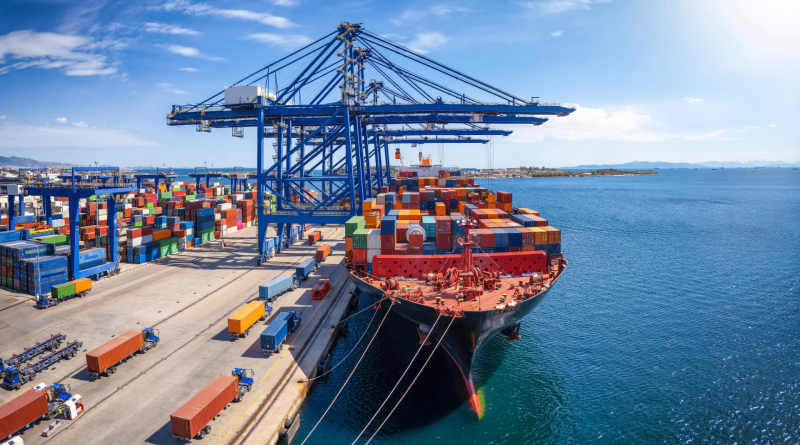
Port congestion keeps container capacity tight as peak season fades
Subscribe to our free newsletter today to keep up to date with the latest supply chain news.
Container shipping’s peak season is gradually easing, but port congestion is still tying up more than 10% of the global fleet, equivalent to 3.6 million TEU, according to DHL Global Forwarding’s November Ocean Freight Market Update.
The logistics provider says global ocean freight demand is up 5% year to date, driven by 8% growth in Asian exports. Fleet capacity is forecast to grow 4% in 2026.
On paper, that should loosen the market. In practice, ships waiting outside congested ports are not completing their rotations, and DHL says global market rates remain more than double last year’s level as congestion keeps pressure on capacity.
For shippers, the message is that seasonal demand is no longer the main factor setting rates. Network disruption is.
Congestion is absorbing the new capacity
The congestion has its roots in Asia. A series of typhoons disrupted the world’s largest export ports in China during late summer, and the knock-on effects have continued to ripple through carrier networks.
Each vessel held at anchor removes capacity from the system just as surely as a blanked sailing. With more than a tenth of the fleet affected, the 4% capacity growth expected this year is largely being offset before it reaches shippers.
The picture varies by trade lane. On Far East westbound routes to Europe, DHL reports volumes up 9% year to date and expects rates to keep rising through year-end on strong demand and congestion at both ends of the trade.
Transpacific eastbound demand is broadly flat. DHL says rates there are stabilizing at high levels and are expected to soften slightly in the fourth quarter, although disruption in Asia continues to affect schedule reliability.
Elsewhere, the pressure points are shifting. Volumes from the Indian subcontinent to Europe and the Mediterranean are down 6% year to date, and congestion has increased in India after cargo surges at key transshipment ports and recent weather disruption.
Asia to Latin America is running hottest, with volumes up 11% year to date to the West Coast and 8% to the East Coast. Utilization above 98% is limiting the usual seasonal downturn and keeping rates volatile.
The transatlantic is the exception. Europe to North America demand is broadly stable, and DHL says capacity continues to exceed demand on that trade.
The return to Suez brings its own disruption
The other major shift is routing. Suez Canal routings continue to return after carriers spent much of the past 3 years sending Asia to Europe services around the Cape of Good Hope.
According to DHL, Gemini, the partnership between Maersk and Hapag-Lloyd, and MSC are returning fastest, with more than half of sailings from Asia to Europe passing through the Suez Canal again as of November.
A shorter route should eventually release vessel capacity, since each voyage takes fewer days. The transition, however, is creating friction of its own. DHL notes that mixed routings and network realignment are affecting schedule reliability, as some services switch routes while others stay on the longer passage.
Changing routes can also bring ships into European and Mediterranean ports in bunches rather than on a steady schedule, adding to terminal pressure at the receiving end.
DHL also advises shippers using the Suez route to verify their cargo protection coverage, a reminder that the security risk in the Red Sea has not disappeared simply because carriers are returning.
Capacity growth may not bring the relief shippers expect
Taken together, the update challenges a common assumption heading into 2027. A growing fleet and a shorter route to Europe would normally point to lower freight rates.
DHL’s view is that the effect may be uneven. As long as congestion keeps a large share of the fleet idle, and route changes keep schedules unreliable, effective capacity will lag behind nominal capacity.
That has practical consequences for procurement. Shippers negotiating annual contracts, particularly on Asia to Europe trades, may find carriers less willing to cut rates than fleet growth figures alone would suggest.
The open question is how quickly the congestion clears. If Asian ports work through their backlogs and the Suez transition settles into stable rotations, the extra capacity could reach the market in the first half of next year.
If not, shippers may spend much of 2027 paying for disruption rather than demand.
Source
DHL Global Forwarding