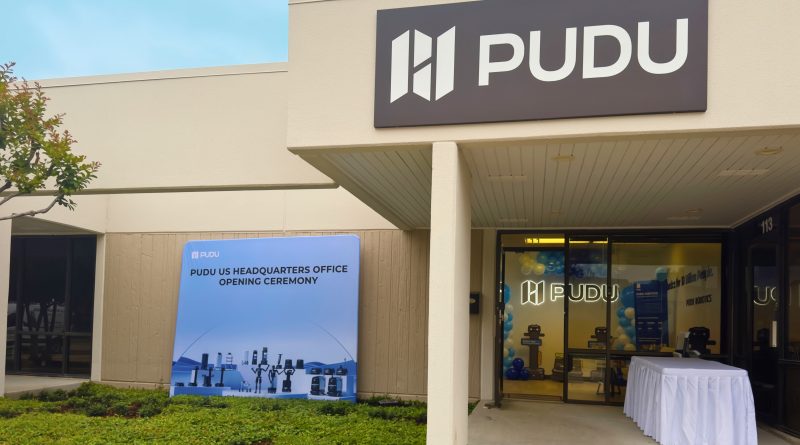
Pudu Robotics establishes Dallas headquarters amid US growth
Subscribe to our free newsletter today to keep up to date with the latest supply chain industry news.
Pudu Robotics’ decision to establish its US headquarters in Dallas marks a calculated step in its push to scale operations across the Americas. The company, known for its service robots used in hospitality and commercial environments, has moved beyond early-stage deployments into a phase defined by regional expansion and operational localization.
The Dallas office is positioned as more than an administrative center. It serves as a coordination hub for sales, service and partner ecosystems across North and South America. With nearly 15,000 robots already deployed in the region and revenue growing at a reported rate of 285% year over year, the company is aligning its physical footprint with demand signals that are becoming harder to ignore.
For robotics firms entering the US market, proximity to customers is becoming a structural requirement rather than a preference. Service robotics, unlike industrial automation, often requires integration with frontline operations such as restaurants, hotels and healthcare facilities. These environments demand faster iteration cycles, localized support and ongoing maintenance frameworks.
Dallas offers a geographic advantage in this context. Its central location reduces logistical friction for a company managing deployments across multiple states. It also provides access to a broad base of enterprise customers that operate distributed service networks. The relocation reflects a wider shift among global robotics companies that are moving closer to end markets to improve responsiveness and build trust with US clients.
Dallas-Fort Worth’s rise as a global headquarters destination
Pudu Robotics is entering a market that has steadily built a reputation as a headquarters destination for both domestic and international companies. Dallas-Fort Worth has attracted 100 corporate headquarters relocations between 2018 and 2024, more than any other metropolitan area in the US.
The appeal is rooted in a combination of economic and operational factors. Texas offers a tax environment that is widely viewed as favorable compared with coastal states. At the same time, Dallas provides access to one of the most extensive logistics networks in the country, including major highways, rail connections and international airports.
Talent availability is another factor shaping relocation decisions. The region has developed a workforce that spans engineering, manufacturing and business operations. This mix is particularly relevant for robotics companies that need to balance hardware development with commercial scaling.
Compared with traditional technology hubs such as Silicon Valley or New York, Dallas presents a different value proposition. It is less centered on venture capital density and more focused on operational efficiency and scalability. For companies like Pudu Robotics, which are transitioning from growth to expansion, this distinction carries weight.
The clustering effect is also becoming more visible. As more companies establish headquarters in the region, they create a network of suppliers, partners and service providers that lowers the barrier to entry for newcomers. This ecosystem dynamic reinforces Dallas’ position as a strategic base for global firms entering the US market.
Service robotics moves from novelty to necessity
The growth trajectory of service robotics provides critical context for Pudu’s expansion. The sector has shifted from experimental deployments to widespread commercial adoption, driven in large part by persistent labor shortages and rising operating costs in service industries.
Global sales of professional service robots reached nearly 200,000 units in 2024, representing a 9% increase. While the growth rate may appear moderate, it reflects a maturing market where adoption is becoming embedded in operational models rather than driven by pilot programs.
In hospitality, robots are increasingly used for tasks such as food delivery within restaurants, room service in hotels and cleaning operations. In logistics, autonomous systems are supporting last-mile delivery and warehouse functions. Healthcare providers are also integrating service robots for routine tasks, allowing staff to focus on higher-value activities.
The economic case for these technologies is becoming clearer. Automation reduces dependency on fluctuating labor markets and improves consistency in service delivery. For businesses operating on thin margins, these gains can translate into measurable financial outcomes over time.
What distinguishes the current phase of adoption is scale. Companies are no longer testing a single unit in one location. They are deploying fleets across multiple sites, integrating robotics into standard operating procedures. This shift requires vendors like Pudu Robotics to provide not just hardware, but also software, analytics and ongoing support.
What Pudu’s move signals for global robotics competition
The relocation also highlights a broader competitive dynamic within the robotics industry. Chinese robotics companies have been expanding into Western markets with increasing confidence, bringing cost advantages and rapid development cycles.
Establishing a US headquarters is part of a localization strategy that addresses regulatory, operational and perception challenges. By building a presence in Dallas, Pudu Robotics can navigate compliance requirements more effectively while presenting itself as a partner embedded in the local business environment.
This move places additional pressure on US-based robotics firms, which must compete not only on innovation but also on cost and scalability. The entrance of global players is likely to accelerate consolidation and partnerships within the sector.
At the same time, the expansion reflects confidence in the long-term growth of the US market for service robotics. As adoption deepens across industries, competition will increasingly center on ecosystem strength rather than standalone products. Companies that can integrate hardware, software and services into a cohesive offering will be better positioned to capture market share.
Dallas, in this context, is becoming more than a geographic choice. It is emerging as a strategic node in the global robotics landscape, where international firms establish a foothold to compete in one of the most important markets for automation technologies.
Source:
Photo credit: