St John Ambulance balances commercial growth, procurement transformation, and community impact to expand lifesaving access
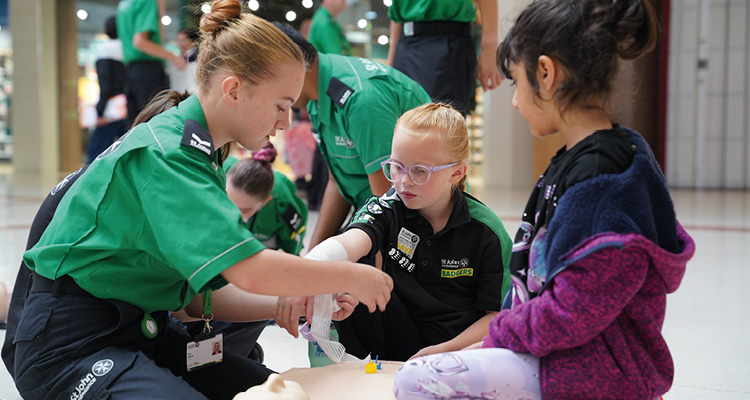
As St John Ambulance gets ready to celebrate its 150th anniversary, the organization blends tradition with new ideas. Most people know St John Ambulance for teaching first aid, supporting communities, and providing medical cover at events across England, but the charity’s vital work goes much deeper. Alongside its passionate volunteer network, youth programs starting from the age of five, ambulance services, and training operations, St John runs a social enterprise that helps fund its broader mission.
The connection between commercial activity and charitable impact places procurement and commercial buying at the center of the organization. Decisions about sourcing, supplier relationships, inventory, and product development influence commercial performance while supporting volunteers, frontline responders, and the communities St John Ambulance serves.
Committed to community
For Nick Winstanley, Head of Commercial Buying and Procurement, that connection forges a direct link between commercial success and charitable impact. “It gives me more of a sense of purpose than just saving the charity money,” Nick opens. “It’s not just about buying effectively; it’s about creating value and reinvesting that back into the charity.”
His responsibilities span procurement strategy across both the charity and its commercial operations, while supporting the workplace training business, event medical services, and first aid supplies division. The procurement function matches the scale of the organization. “I lead on setting the procurement and tendering strategy for charity and commercial activity, overseeing supplier selection, contract management, and performance.”
His input has grown more important as St John Ambulance expands its commercial activities and finds new ways to support its mission. Over the past two years, one of Nick’s top priorities has been reshaping the buying function. The process began with a review of the supplies business, moving from traditional buying to category management by bringing in experienced Category Manager, Andy Leonard. “We identified that we’d got far too many products and suppliers, and we needed to focus on where we were going to add value,” Nick notes. “In our defibrillation category, we stopped selling about 50 percent of our products and focused on fewer carefully-curated ranges that we could do well and support well.” This was carried out in tandem with leveraging the opportunity to build products under the St John Ambulance brand. “My team identified a gap in the market. We know we’ve got a wealth of experience from being nearly 150 years old and that’s why we started to look at developing our own range of defibrillation products,” he adds.
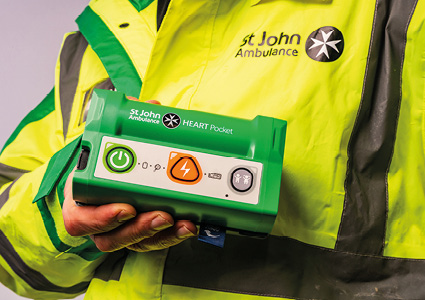
The result was the launch of the HEART range, including the HEART One and HEART Two defibrillators. The most recent addition, the HEART Pocket AED, reflects how clinicians, procurement, product development, governance, and operations now work together across the organization.
The HEART Pocket AED was developed to tackle a simple challenge: reducing the time between cardiac arrest and treatment. “Research shows that for every minute that a patient doesn’t receive defibrillation, their chances of survival diminish by ten percent. It’s really important to get there and give them the treatment needed as quickly as possible. This product is about putting the power in the hands of responders so they can react instantly.”
Small enough to fit in a pocket and weighing around 700 grams, the unique HEART Pocket AED, sold exclusively by St John Ambulance in the UK, is already being carried by the charity’s cycle responders. Interest has followed from sectors including emergency services, transport operators, sports venues, and housing developers.
From idea to reality
Bringing the innovative product to market required contributions from across the organization. “This isn’t a single department that can take the credit. Our governance team, commercial sales team, supply chain team, and equipment management team all played a huge part in bringing the product to market. It’s a collaborative sourcing exercise within St John Ambulance.”
Getting a product to market is one thing but keeping it on shelves is another. Like many organizations in healthcare and medical equipment, St John Ambulance faces inflationary pressures, geopolitical disruptions, and shifting supplier conditions. Rather than treating those factors as isolated problems, procurement keeps its focus on continuity. “We want to make sure that customers get the products they need when they need them, and that pricing is secured so we don’t have to force through unnecessary price rises. We work very closely with our strategic suppliers to make sure we’ve got stock and that long lead times don’t affect availability,” Nick clarifies.
Maintaining consistency requires visibility throughout the supply chain and confidence in the products. Because volunteers and staff use many of these products themselves, compliance and quality are not just a checkbox. “Our reputation is key,” Nick states. “We want to make sure we’re not selling products that we don’t endorse and don’t support. We go above and beyond regulatory requirements by having our medical engineering team verify that supplier assumptions and promises are correct before final approval from our medical director, Dr Lynn Thomas”
Verification is just one part of the process. Understanding demand, risk, and inventory calls for a different kind of rigor. St John Ambulance relies on analytics to understand customer demand, manage inventory, assess trends, and support informed buying decisions. Better visibility allows teams to anticipate requirements rather than react to them.
Turning insight into action has required investment in new technology. A new website has improved how users navigate product ranges and access information, while future investments are expected across areas including contract management and operational infrastructure.
Greener supply and a wider reach
At the same time, sustainability is shaping both purchasing decisions and product development. Earlier this year, St John Ambulance achieved a successful ISO14001 environmental management systems audit and has since received full accreditation. Across its estate, the organization is rolling out projects to address energy use and vehicle electrification. Within the supplies business, there’s growing focus on product design, packaging, and materials. “We’ve started to wrap our tubular bandages in medical-grade paper to remove plastic,” Nick shares. “We’ve introduced plastic-free plasters with bamboo pulp and moved products into cardboard packaging as part of reducing plastic across the range.”
Such initiatives support broader organizational objectives that extend well beyond procurement. By 2028, St John Ambulance aims to train 800,000 people in first aid each year, with at least 85 percent confident enough to use those skills when needed. Plans tied to category development and new products are in the pipeline. “From a procurement perspective, it’s about innovation and sustainability. We’re going to continue to expand our HEART product range, look at new products in first aid kits and consumables, and identify further gaps in the market.”
As St John Ambulance enters its next chapter, the focus remains on increasing access to life-saving skills, equipment, and support. Procurement may sit behind the scenes, but its influence impacts every part of that mission. “Our purpose is to put the power of first aid in people’s hands, equip communities with life-saving skills, and give them the knowledge and confidence to act when it matters most,” Nick concludes.
For more information about St John Ambulance supplies Visit shop.sja.ork.uk/s/scw