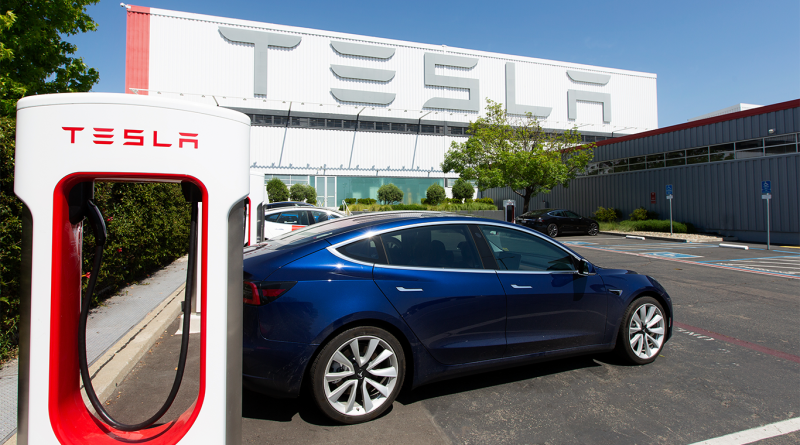
Tesla to invest $1.4 million in new Texas distribution hub
Subscribe to our free newsletter today to keep up to date with the latest renewable energy news.
Tesla is preparing to occupy a 538,720-square-foot distribution facility near Austin, adding another large industrial property to a Texas operation that already extends well beyond vehicle assembly.
A Sept. 1 filing with the Texas Department of Licensing and Regulation identifies Tesla as the company behind a lease-space build-out at Mustang Ridge Distribution Center I in Travis County. The project carries an estimated cost of $1,435,878, with work scheduled to begin Dec. 7, 2026, and finish Dec. 4, 2028.
The $1.4 million investment figure requires some context because it does not represent the cost of constructing the warehouse from the ground up. State records describe Tesla’s project as a build-out inside an existing office and warehouse structure, while a separate filing for the distribution center shell lists an estimated construction cost of $25 million.
That distinction shifts the focus away from the relatively modest tenant-improvement budget and toward the scale of the logistics capacity Tesla is preparing to occupy near one of its most important manufacturing sites.
Tesla is adding logistics capacity around a large manufacturing base
The Mustang Ridge project sits within Tesla’s broader industrial presence in Central Texas, where the company’s Gigafactory Texas site near Austin covers 2500 acres and contains more than 10 million square feet of factory floor. The facility produces Model Y vehicles and Cybertrucks and serves as the company’s global headquarters.
A manufacturing operation of that size depends on a network of facilities beyond the production floor, including space for inbound components, inventory storage, sequencing, outbound freight and supplier activity. Warehouses positioned close to a major plant can help manufacturers manage those flows without using higher-value factory space for functions that can be handled elsewhere.
Tesla has not disclosed what will move through the Mustang Ridge facility, and the state filing does not establish whether the building will support parts, finished vehicles, equipment or another operational function. The absence of those details limits any firm conclusions about its role, but the scale of the facility still makes it relevant to companies following Tesla’s supply-chain development.
At 538,720 square feet, the warehouse represents a substantial block of industrial space and points to the amount of supporting infrastructure required around a large manufacturing base. The project also shows how investment associated with major factories can spread beyond the plant itself as companies add storage, distribution and supplier capacity around core production operations.
For Tesla, that supporting network is becoming a more visible part of its presence around Austin. Gigafactory Texas may remain the focal point, but facilities such as Mustang Ridge indicate that the company’s physical footprint is expanding through logistics infrastructure as well as manufacturing capacity.
The project arrives as Austin works through an industrial supply cycle
Tesla’s move also comes at an important stage for the Austin industrial property market, where warehouse development has expanded sharply in recent years and occupiers are now absorbing a large amount of newly delivered space.
CBRE reported 1.4 million square feet of net industrial absorption during the second quarter of 2026, representing an increase of 244.8% from the previous quarter and 89.3% from a year earlier. Those figures point to stronger leasing activity, although vacancy remained elevated at 19.4% after falling 70 basis points during the quarter.
The market still had 5.9 million square feet of industrial property under construction, according to CBRE, although that pipeline had fallen substantially from its 2023 peak of 13.3 million square feet. The figures describe a market that has built aggressively and is now working through the resulting supply.
For industrial developers, landlords and logistics operators, tenants capable of taking several hundred thousand square feet can have a meaningful impact on individual projects and submarkets, particularly when vacancy remains elevated. Tesla’s Mustang Ridge facility places the company firmly in that category of large industrial occupier.
The project may also be instructive for businesses watching the relationship between manufacturing investment and warehouse demand. New factories often attract most of the attention, but the distribution networks surrounding those facilities can generate a second layer of industrial activity involving storage, freight handling, supplier operations and inventory management.
Austin has seen that pattern unfold against a backdrop of rapid construction. CBRE reported that 27.9 million square feet of industrial space had been delivered during the three years preceding its second-quarter 2026 report, creating a large pool of modern warehouse capacity across the region.
As construction slows from earlier peaks, major occupiers can help absorb existing supply without requiring another cycle of speculative development. Tesla’s decision to build out space within an existing warehouse shell fits that pattern and gives the company substantial distribution capacity without the need for another ground-up facility.
Mustang Ridge adds another layer to Tesla’s Texas footprint
The precise operational role of the Mustang Ridge facility remains unclear because the regulatory filing establishes the location, size, cost and construction schedule without describing the goods or processes the building will handle.
That leaves open questions for suppliers, logistics companies and industrial developers watching Tesla’s Austin operations. Depending on how the property is eventually used, it could affect freight flows, inventory positioning and supplier activity across the region, although those effects cannot be established until more detail emerges or operations begin.
What can be established is the scale of the commitment. A 538,720-square-foot distribution facility represents substantial logistics infrastructure when placed alongside a manufacturing operation already measured in millions of square feet.
The project offers another example of how advanced manufacturing investment extends beyond assembly plants themselves. Large factories rely on warehousing, transportation, inventory management and supplier coordination, and each of those functions creates additional demand for industrial real estate.
Tesla’s $1.4 million build-out is therefore more significant than the headline investment figure alone might suggest. The larger story is the 538,720 square feet of distribution capacity being added to a growing Texas network that increasingly combines manufacturing with the logistics infrastructure required to support it.
Source:
CBT News