TSMC posts record profits on booming AI chip demand
Subscribe to our free newsletter today to keep up to date with the latest supply chain industry news.
Taiwan Semiconductor Manufacturing Company’s first-quarter results point to a decisive shift in how demand is forming across the semiconductor industry. The company reported a 58 percent increase in profit year over year, with revenue climbing sharply as customers accelerated orders tied to artificial intelligence workloads.
The scale of the growth reflects more than a strong quarter. It signals a structural change in demand composition. High-performance computing, largely driven by AI training and inference, now represents the majority of TSMC’s business. This marks a departure from previous cycles, where smartphones and consumer electronics dictated volume and pricing dynamics.
At the center of this transition is the rapid adoption of advanced process technologies. Chips built on 3nm and 5nm nodes accounted for a dominant share of wafer revenue, underscoring how AI applications require increasingly dense and power-efficient architectures. Training large language models and running inference workloads at scale depend on chips that can deliver performance gains without proportional increases in energy consumption.
This shift is changing the economics of semiconductor manufacturing. Advanced nodes command higher margins, require more complex fabrication processes, and create higher barriers to entry. As a result, demand tied to AI is not only larger in scale but also more profitable, reinforcing TSMC’s position as a central player in the global chip ecosystem.
Capacity expansion meets supply chain constraints
TSMC’s response to sustained AI demand is aggressive capital deployment. The company has outlined capital expenditures between $52 billion and $56 billion for 2026, aimed at expanding fabrication capacity and maintaining leadership in advanced nodes.
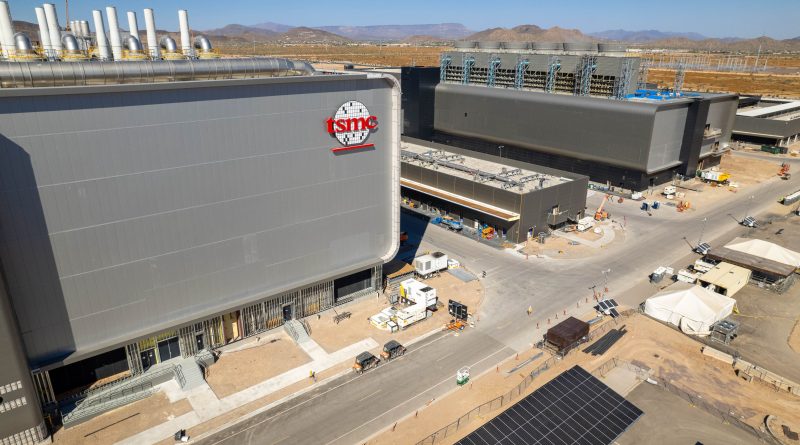
This expansion is not limited to Taiwan. The company continues to invest in overseas facilities, reflecting both customer demand for geographic diversification and government pressure to localize semiconductor production. These projects introduce new layers of complexity in construction, workforce development, and supply chain coordination.
Upstream pressure is already visible. Equipment suppliers, specialty chemical producers, and materials providers are facing tighter timelines as fabs scale output. Advanced lithography systems remain a bottleneck due to their cost and limited availability. Lead times for key equipment can stretch into years, constraining how quickly capacity can come online.
Geopolitical factors add another layer of uncertainty. Trade restrictions, regional tensions, and shifting alliances are reshaping how companies approach supply continuity. For TSMC, balancing efficiency with resilience has become a core operational challenge as it scales production to meet AI-driven demand.
Margins and pricing power redefine competitive dynamics
One of the most striking elements of TSMC’s latest results is its gross margin, which has approached levels not seen in decades. This reflects a combination of strong demand, limited competition in advanced nodes, and the company’s ability to price its services at a premium.
Unlike mature nodes, where pricing is often subject to cyclical swings, advanced manufacturing operates in a more constrained environment. Few companies have the technical capability or capital resources to compete at the leading edge. This gives TSMC significant leverage in negotiations with customers, many of whom depend on its technology roadmap to bring their own products to market.
The customer mix reinforces this advantage. Leading technology firms such as Nvidia and Apple rely heavily on TSMC for their most advanced chips. As AI adoption accelerates, these customers are increasing order volumes and securing capacity well in advance to avoid shortages.
This dynamic is shifting the broader competitive landscape. Foundries that focus on older process nodes are finding it harder to capture growth tied to AI, while integrated device manufacturers face challenges in matching TSMC’s scale and specialization. The result is a widening gap between leaders in advanced manufacturing and the rest of the industry.
A leading indicator for the next semiconductor cycle
TSMC’s outlook suggests that current demand trends are not short term. The company expects strong revenue growth to continue through 2026, supported by sustained investment in AI infrastructure across cloud providers, enterprises, and governments.
This has implications beyond the semiconductor sector. Increased chip production feeds into data center expansion, networking upgrades, and applications in areas such as autonomous systems and industrial automation. Each layer of this ecosystem depends on continued improvements in chip performance and efficiency.
The scale of projected global semiconductor spending points to a broader cycle driven by AI rather than traditional consumer demand. Unlike previous upcycles, which were often tied to device refresh cycles, the current wave is anchored in long-term infrastructure buildout.
For industry participants, this creates both opportunity and risk. Companies aligned with AI-driven demand stand to benefit from sustained growth, while those tied to legacy segments may face slower expansion. TSMC’s performance offers a clear signal of where value is concentrating and how the next phase of the semiconductor industry is likely to unfold.
Sources